
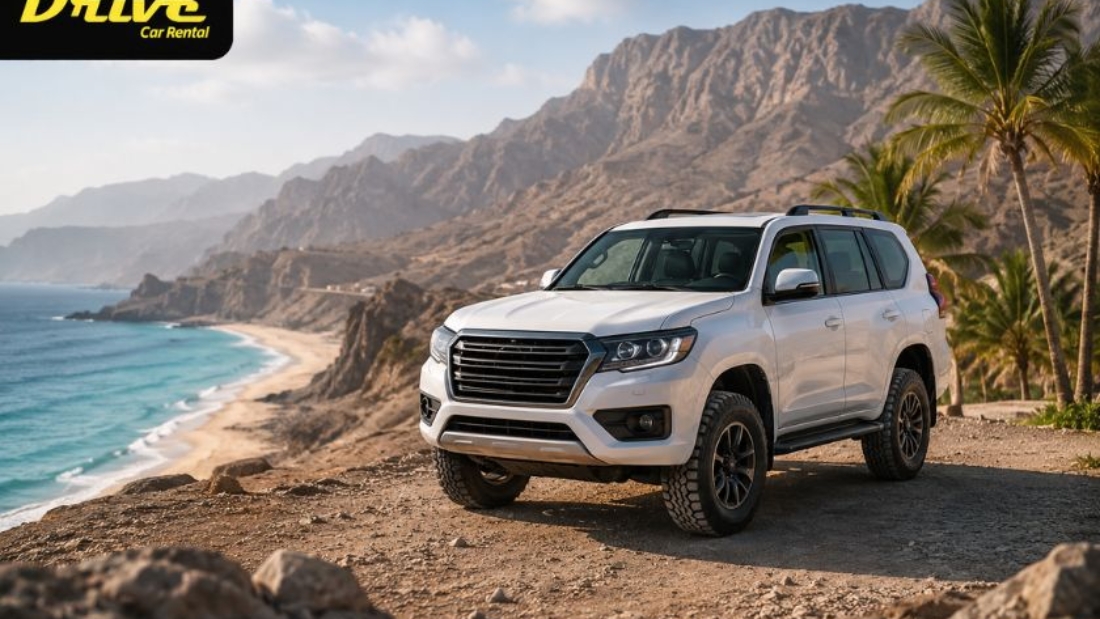
Salalah looks calm from the coast road, but a few kilometres inland the terrain changes fast. The Dhofar mountains climb steeply behind the city, the Khareef season turns the hillsides slippery with fog and mud, and the road toward the Empty Quarter runs through open sand where a regular sedan simply won’t cope. That’s the short answer to why so many travellers search for car rental Salalah 4×4 instead of booking a standard sedan: the landscape here demands it more often than most people expect.
This guide covers what a 4×4 actually gives you over a normal car, who really needs one, what it costs to rent one in Salalah, what to inspect before you drive off, and which off-road models are worth booking.
What Makes 4×4 Rental Different in Salalah
A 4×4 (or 4WD) sends power to all four wheels instead of two, which changes how the car behaves the moment the surface stops being flat tarmac. In Dhofar, that difference shows up in a few very specific situations:
Sand and desert tracks. If your plan includes even a short detour toward Wahiba Sands or the edge of the Empty Quarter, a two-wheel-drive car will bog down in loose sand within minutes. A 4×4 with proper ground clearance and the right tyre pressure handles this without drama.
Mountain roads during Khareef. Between June and September, the monsoon fog rolls over the Jebel Qara and Jebel Samhan ranges and the switchback roads get wet and misty. Extra traction on the climbs and descents around Wadi Darbat or Jebel Samhan matters here, and it’s something we’ve covered in more detail in our piece on SUV vs sedan for the Dhofar mountains.
Unpaved and gravel routes. Several of Dhofar’s best spots, hidden wadis, remote beaches, frankincense groves, sit past where the asphalt ends. A 4×4 gets you there without scraping the underside of the car or getting stuck.
Ground clearance and stability. Even on paved roads, a taller 4×4 gives a clearer view of the road, handles Oman’s occasional sudden potholes better, and generally feels steadier when loaded with luggage and passengers.
None of this means a sedan is a bad choice for Salalah. If your trip is mostly city driving, beach visits, and short highway runs, a sedan is cheaper and perfectly capable. A 4×4 earns its higher rate specifically when sand, mountains, or unpaved tracks are part of the plan.
Who Should Choose a 4×4 in Salalah
Desert safari and Empty Quarter travellers. If dune driving or an overnight desert camp is on your itinerary, this isn’t optional. Regular tyres and low clearance aren’t built for that terrain.
Families or groups heading into the Dhofar mountains. Wadi Darbat, Ayn Athum, Jebel Samhan, and the Khareef viewpoints are far more comfortable and safer to reach in a 4WD, especially with kids or older travellers in the car.
Photographers and nature travellers. A lot of Dhofar’s best views, waterfalls, hidden coves, mountain plateaus, sit off the main road. A 4×4 opens up routes a sedan can’t reach.
Longer road trips beyond Salalah. If you’re driving further afield, toward Muscat, the Wahiba Sands, or along the coast, a 4×4 gives more confidence over the varied terrain along the way.
Who can skip it: If you’re staying mostly within Salalah city, visiting the beaches, museums, and souqs, or making short day trips on paved roads, a sedan like the Toyota Corolla or Hyundai Creta will do the job for less money. Our guide on what to check before renting a car in Oman covers the basics that apply no matter which vehicle type you pick.
4×4 Car Rental Prices in Salalah
Rates for 4x4s in Salalah generally sit above sedan pricing because of the vehicle size, fuel consumption, and demand during peak Khareef months (July to September). As a rough guide:
| Rental Period | Typical 4×4 Rate Range |
|---|---|
| Daily | Moderate, higher than a sedan, varies by model and season |
| Weekly | Discounted per-day rate compared to daily bookings |
| Monthly | The best per-day value, popular with long-stay residents and business travellers |
A few things that affect the final price:
- Model and size. A Kia Sportage 4WD will usually cost less than a Nissan Patrol or Toyota Fortuner, since the latter are larger, more powerful vehicles.
- Season. Khareef season (June to September) sees the highest demand for 4x4s, so booking early helps lock in a better rate.
- Rental length. Weekly and monthly rentals bring the daily cost down noticeably compared to booking day by day.
- What’s included. Always confirm whether insurance, unlimited mileage, and airport pickup are bundled into the quoted price, or charged separately.
At Drive Car Rental, quotes are given upfront with no hidden add-ons, and we don’t ask for a credit card or security deposit to confirm a booking. For an exact rate on a specific model and date range, it’s quickest to check our vehicle fleet or send us your dates directly.
What to Check Before Renting a 4×4 in Salalah
A 4×4 is a bigger, more expensive vehicle than a city car, so it’s worth a slightly closer look before you sign anything.
Confirm it’s genuinely 4WD, not just SUV-styled. Some SUVs are two-wheel drive with a raised body. If off-road capability matters for your trip, ask specifically whether the vehicle has selectable or automatic 4WD.
Check tyre condition. Off-road driving is harder on tyres than city roads. Walk around the car and check tread depth and sidewall condition before you leave the lot.
Ask about the spare tyre and recovery kit. A full-size spare, jack, and basic recovery gear (like a tow strap) matter more once you’re away from paved roads.
Understand the fuel policy. Most rentals expect the car returned with the same fuel level it was collected with. A 4×4 burns more fuel than a sedan, so factor that into your budget.
Confirm insurance coverage for off-road use. Some policies exclude damage from off-road or desert driving. Ask directly whether desert or off-road use is covered, not just standard road driving. Our breakdown on rental car insurance in Oman explains what’s typically included.
Have the right documents ready. Tourists generally need a passport, a valid driving licence, and in many cases an International Driving Permit. We’ve covered this in detail in our guide on whether you need an international driving licence to rent a car in Oman.
Ask about roadside assistance. If your route heads toward remote wadis or the desert, confirm the rental company offers 24/7 support in case of a breakdown far from town.
Learn basic desert driving prep. If dune driving is part of your plan, it’s worth reading up on tyre deflation and desert driving basics before you go. Our guide on preparing for desert driving in Oman covers tyre pressure, water, navigation, and what to do if you get stuck.
Best Off-Road 4×4 Cars to Rent in Salalah
Here’s a rundown of the 4WD models available in our fleet, matched to the kind of trip each one suits best.
Nissan Patrol 2023 4WD The Patrol is the heavyweight choice for serious off-road and desert work. It has strong power, high ground clearance, and enough cabin space for a family with luggage. Best for dune driving, longer desert routes, and anyone who wants the most capable option in the fleet. Read more in our guide on why the Nissan Patrol is the ultimate SUV for Oman adventures.
Toyota Fortuner V6 4000 CC A well-balanced choice between comfort and off-road ability. The V6 engine handles mountain climbs and sand tracks confidently, while the cabin stays comfortable enough for daily city use too. Good for mixed itineraries that combine Dhofar mountain drives with city and coastal days. Full details in our Toyota Fortuner V6 guide.
Nissan Xterra 4WD A rugged, no-frills off-roader built for rough terrain. It’s a solid pick for smaller groups or solo travellers who want genuine off-road capability without the size and running cost of a full-size SUV. More in our Nissan Xterra 4WD review.
Hyundai Tucson 4WD A more compact, fuel-efficient 4WD that still handles mountain roads and light off-road tracks well. Suits travellers who want some off-road ability without stepping up to a larger, thirstier SUV. Details in our Hyundai Tucson 4WD guide.
Kia Sportage 2023 4WD The most budget-friendly 4WD in the lineup, good for travellers who want the added traction and clearance of a 4×4 without paying full SUV rates. Works well for mountain sightseeing and light off-road stretches. See our Kia Sportage rental guide for more.
For a side-by-side look at the full range, including sedans, our vehicle fleet page lists everything currently available with photos.
Frequently Asked Questions
Do I need a 4×4 to visit the Empty Quarter or Wahiba Sands from Salalah?
Yes. Both routes involve stretches of loose sand that a two-wheel-drive car can’t manage safely. A proper 4WD with correct tyre pressure is the standard way to make this trip.
Is a 4×4 necessary just to explore Salalah city?
No. For city driving, beaches, and paved day trips, a sedan is cheaper and perfectly adequate. A 4×4 makes sense once your plans include sand, mountains, or unpaved roads.
Can I rent a 4×4 without a credit card or deposit?
At Drive Car Rental, yes. We don’t require a credit card or security deposit to confirm a booking, which keeps the process simpler for both residents and tourists.
Can I pick up a 4×4 directly at Salalah Airport?
Yes, pickup and drop-off are available right at the airport, so you can start driving as soon as you land. See our Salalah Airport car rental page for details.
What documents do I need to rent a 4×4 in Oman?
Tourists typically need a passport, their home driving licence, and an International Driving Permit if the licence isn’t in Arabic or English. Omani residents need a valid Omani driving licence and resident ID.
Booking Your 4×4 in Salalah
If your trip includes anything beyond city streets and paved highways, a 4×4 is the difference between an easy drive and a stressful one. Drive Car Rental has been operating in Salalah for over 11 years, with more than 100 vehicles in the fleet and no hidden fees on any quote.
Call or WhatsApp us at +968 9265 9484, or visit our homepage to check current rates and availability for car rental in Salalah, including 4×4 models ready for airport pickup.

